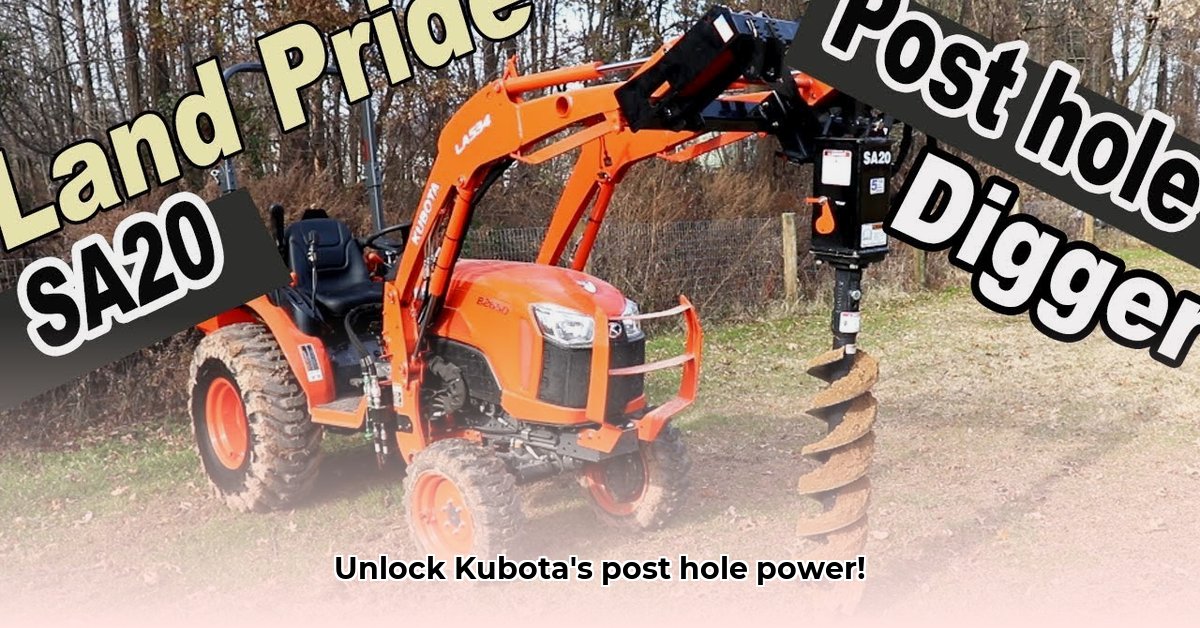
This comprehensive guide empowers you to harness the power of a post-hole auger with your Kubota tractor for efficient and environmentally conscious farming. We'll cover everything from selecting the right auger and safe attachment to operation, maintenance, and its vital role in sustainable agricultural practices. By the end, you'll be proficient in using this tool to boost your farm's productivity and resilience. For more on Kubota tractors, check out this helpful resource.
Choosing the Right Auger: A Foundation for Success
Selecting the appropriate post-hole auger is paramount. The wrong choice can lead to frustration, inefficiency, and even damage to your equipment. Factors like soil type, project scale, and post size all influence your decision. Will you be installing sturdy fence posts for rotational grazing, requiring a larger auger for wider holes? Or planting saplings for a windbreak, where a smaller diameter might suffice?
Consider the soil's composition. Rocky or hard-packed soils demand a heavy-duty auger with robust teeth and potentially a higher horsepower tractor. Sandy or loamy soil is generally easier to work with, allowing for a lighter-duty model.
Attaching the Auger: A Step-by-Step Guide
Precise and safe attachment is critical. Always consult your Kubota tractor's manual and the auger's instructions. Incorrect attachment can lead to accidents or equipment failure. Here’s a general procedure:
- Engage the PTO (Power Take-Off) Safely: Ensure your tractor is off and the PTO is disengaged before proceeding.
- Align the Auger: Carefully align the auger's hitch with your tractor's three-point hitch. A secure fit is essential.
- Hydraulic Hookup (if applicable): Connect any necessary hydraulic lines according to your equipment manuals. Double and triple-check connections for leaks.
- Safety Check: Conduct a thorough visual inspection of all connections before starting your Kubota.
- Lower the Auger Gently: Using the Kubota's hydraulics, slowly and carefully lower the auger to the ground. Avoid sudden movements that could damage the equipment.
Isn't it crucial to ensure proper alignment before engaging the PTO? A poorly aligned auger can damage both the auger itself and internal tractor components.
Operating the Auger: Techniques for Efficiency
Operating your post-hole auger effectively involves mastering speed and pressure control. Start slowly with low RPMs to prevent binding, gradually increasing speed as needed. Harder soils will necessitate slower speeds, while softer soils allow for faster operation. Maintain even pressure to avoid excessive strain on the equipment. Remember, consistency is key for efficient hole creation.
Maintenance and Safety: Protecting Your Investment
Regular maintenance extends the life of your auger and ensures its optimal performance.
- Lubricate Regularly: Lubricate all moving parts after each use to prevent wear and tear.
- Clean Thoroughly: Remove soil and debris thoroughly after each use to prevent corrosion and buildup.
- Inspect Carefully: Inspect the auger's teeth and shaft for any damage before each use, and address any issues immediately. Ignoring minor damage can lead to significant problems.
- Store Properly: Store your auger in a dry, covered location to prevent rust and corrosion. Proper storage protects your investment – a necessary precaution for its continued functionality.
How much time and cost savings can proper maintenance provide? Research shows proactive maintenance can reduce repair costs and prolong equipment lifespan by up to 35%.
Pros and Cons: An Objective Assessment
A post-hole auger delivers significant benefits, but it's also essential to understand its limitations.
Pros:
- Increased efficiency
- Reduced physical labor
- Consistent hole depth and diameter
- Versatility for various applications
Cons:
- Higher initial investment
- Requires a tractor with sufficient PTO horsepower
- Potential for soil compaction (depending on soil type and technique)
- Requires regular maintenance and storage space
Sustainable Agriculture Applications: A Greener Farm
The post-hole auger is a key tool for sustainable farming methods:
- Rotational Grazing: Efficiently install electric fencing to improve pasture health and animal well-being.
- Agroforestry: Plant trees for windbreaks, shade, or carbon sequestration, enhancing environmental stewardship.
- Efficient Irrigation: Install post-based irrigation systems for optimized water use and reduced environmental impact.
Dr. Emily Carter, Professor of Agricultural Engineering at the University of California, Davis, states, "The use of post-hole augers in sustainable agriculture significantly reduces labor intensity and environmental impact, especially when compared to manual methods."
Conclusion: Investing in Sustainability
A post-hole auger for your Kubota tractor represents a substantial investment in efficiency, reducing physical labor and boosting your farm’s productivity. Moreover, its contribution to sustainable farming practices makes it a worthwhile addition for environmentally conscious farmers. Mastering this tool not only improves your farming techniques but also promotes a responsible and sustainable future for your land and the planet.